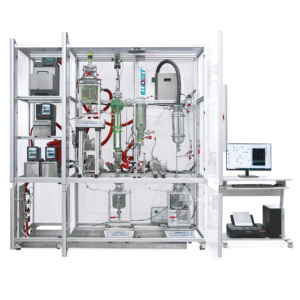
Short Path Evaporator KV 80
Short Path Evaporators are used in chemical industry for the production and processing of macro-molecular substances. Because of the thermal sensitiveness of products, this separation method is applicable. The sample to be distilled is exposed only for a very short time to the heating substances because the film, created by the wiper, can evaporate very quickly. The residence time of medium on the heating surface is a matter of seconds, thus essentially less than in a reboiler flask, circulating evaporator etc. The evaporated product (operation pressures down to 10-3 mbar and temperatures up to about 300°C) has to pass a “short path” to the condenser only, which is located in the middle of the evaporator.
Evaporators in borosilicate glass 3.3 are available with heat exchange areas 0.02…0.8 m².
Evaporators in stainless steel can be heated by a heating jacket to higher temperatures with more heat transfer area for higher throughputs.
What can we do for you?
If you want more specific information regarding this product, please contact our Sales team.
We are happy to assist you.

Features & Benefits
- Short Path Evaporators are utilized in the chemical industry for processing macro-molecular substances, particularly suitable for thermally sensitive products.
- The method involves exposing the sample to be distilled for a brief duration to heating substances, facilitated by the rapid evaporation of the film created by the wiper.
- The residence time on the heating surface is significantly shorter, measured in seconds, compared to traditional methods like reboiler flasks and circulating evaporators.
- The evaporated product, operating under pressures as low as 10-3 mbar and temperatures reaching around 300°C, efficiently travels a “short path” to the centrally located condenser within the evaporator.
- Evaporators in borosilicate glass 3.3 are available with heat exchange areas ranging from 0.02 to 0.8 m².
- Stainless steel evaporators, equipped with a heating jacket, offer higher temperature capabilities and increased heat transfer area to accommodate larger throughputs.